
The Association for the Advancement of Baltic Studies is pleased to recognize Rūta Matimaitytė for the successful completion of her AABS Dissertation Grant, awarded in 2024.
AABS awards grants of up to $4,000 to support doctoral dissertation research and write-up in any field of Baltic Studies. Funds may be used for travel to research site, equipment, duplication or other needs as specified.
Matimaitytė used the grant to support her doctoral dissertation project, “Children’s Migration to Soviet Lithuania (1944–1960): History, Memory, and Trauma.” She provided a report at the conclusion of her research, which we publish below with light editing.
Rūta Matimaitytė is a historian and a PhD candidate at the Lithuanian Institute of History. Her doctoral dissertation is entitled “Migration of Children to Soviet Lithuania: History, Memory and Trauma.” Matimaitytė’s research on the German children of East Prussia earned her the Prize of the Department of National Minorities, as well as the Vytenis Andriukaitis Award and the Antanas Smetona Scholarship from the Lithuanian Academy of Sciences. She has completed fellowships at Goethe University in Frankfurt am Main, the Herder Institute, and the Nord–Ost Institute in Lüneburg. Matimaitytė holds a BA summa cum laude and MA magna cum laude from the Department of History of Vilnius University.
The Memory of Migration
Dissertation Grant Report from Rūta Matimaitytė
Background
Between July 2024 and May 2025, during the academic year, I had the opportunity to carry out research for my doctoral dissertation project entitled “Children’s Migration to Soviet Lithuania (1944–1960): History, Memory, and Trauma,” with the support of the AABS Dissertation Grant. The AABS Dissertation Grant provided me with the opportunity to expand my research on the Nordic and Baltic countries and to gain a deeper understanding of postwar refugee processes at various levels, including historical experiences, cultural contexts, and trauma. I conducted my research in Germany, Sweden, Denmark, Latvia and Estonia. Visiting such a wide range of countries would not have been possible without the invaluable assistance of the grant administrators, whose support was essential in addressing any challenges encountered.
Introduction
The dissertation project, titled “Children’s Migration to Soviet Lithuania (1944 – 1960): History, Memory, and Trauma,” aims to explore how narratives of child migration were shaped and reshaped by shifting political and ideological perspectives. Working with a specific group such as children is particularly challenging: archival research is time-consuming, and even understanding the broader significance of children’s issues requires careful examination. The traumas of Second World War often remain unspoken: survivors are rarely inclined to openly share their experiences, as these events continue to evoke inner pain. Therefore, implementing projects of this type is always challenging, as the highly interdisciplinary nature of migration studies requires additional engagement with other fields such as sociology, psychology, or even medicine. The latter is explored in this dissertation through the investigation of links between epidemics and migration.
Specifically for the AABS dissertation project, the aim is to refute the hypothesis prevalent in public discourse, expressed by the phrase “they all went to Lithuania.” To achieve this goal, a broader context was incorporated, examining the migration of East Prussians to Denmark, Sweden, and other Baltic states—Latvia and Estonia. In pursuit of this objective, I conducted interviews, visited archives, and carried out research in museums and research centers in Denmark, Sweden, Germany, Latvia, and Estonia. The short-term work conducted in these countries will be integrated into my dissertation as contextual material that will help frame the analysis.
Germany
In Germany, I reviewed documents from several institutions: in the Red Cross offices in Munich and Hamburg, I analyzed the disappearance of German children, their search, and later attempts to reunite families. The analysis of these archives allowed me to understand that the fates of German children who ended up in Soviet Lithuania, their places of death, and their subsequent destinies are much less well documented than those who ended up in Denmark, where a refugee camp operated.
In Berlin, I also analyzed materials from the Bundesarchiv, which showed how extensively the histories of those who ended up in Denmark and their subsequent return were documented. It is important to mention that in Berlin I visited the Flucht Vertreibung Versöhnung Center, which, alongside other migration topics, preserves stories of both Wolf children and those who ended up in Denmark. At this center, I worked in their archives, which hold personal accounts and children’s histories.
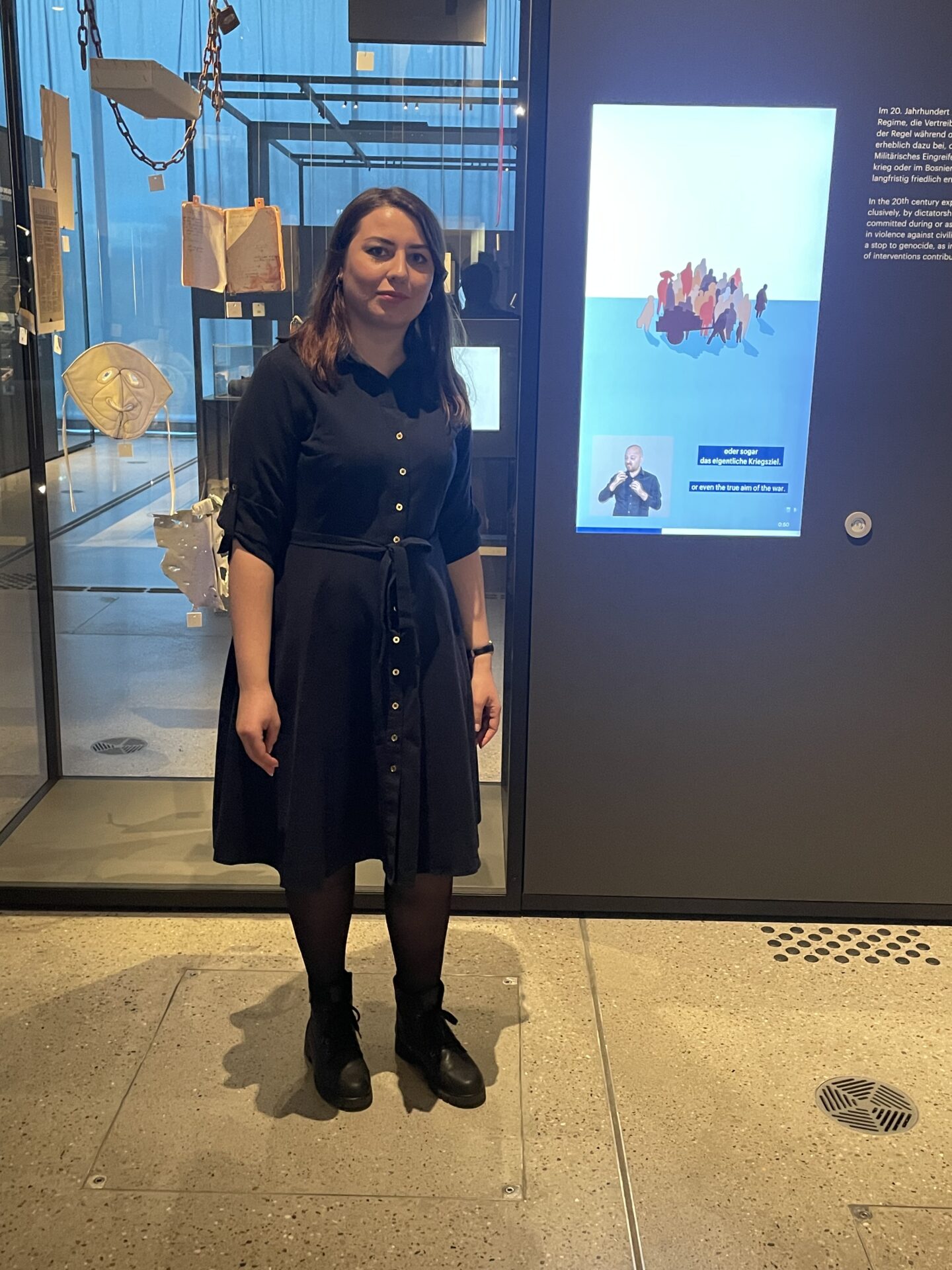
Rūta next to the Flucht Vertreibung Versöhnung exhibition
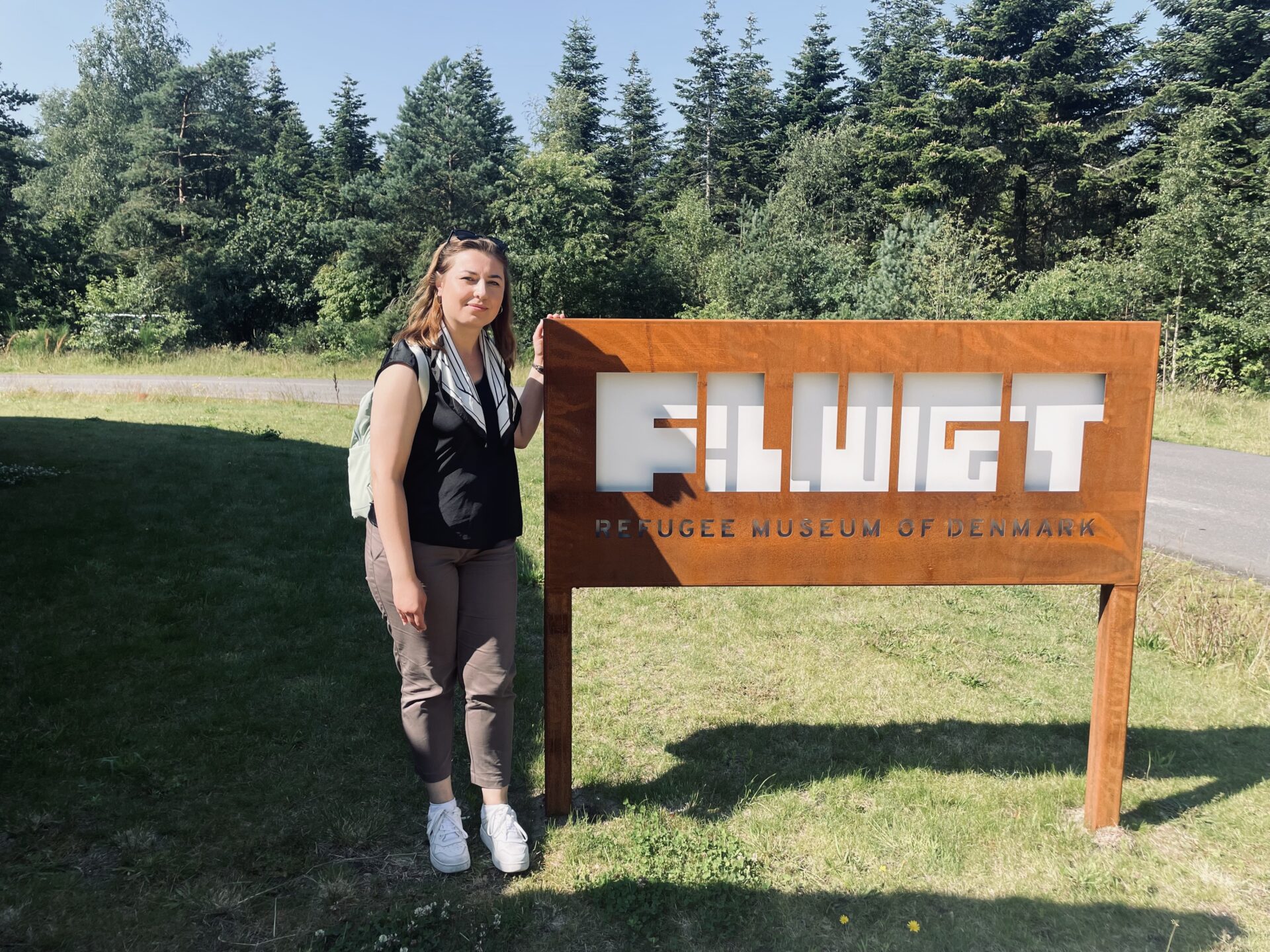
Rūta near the museum dedicated to German refugees in Denmark
Denmark and Sweden
Following the history of those who ended up in East Prussia, I continued my work in archives in both Sweden and Denmark. While working in this region, it was especially important to visit the first museum established at a former refugee camp in Denmark, dedicated to the migration of East Prussians to Denmark. While working in the Stockholm archive in Sweden, I discovered a story worthy of a film about an East Prussian woman who secretly tried to enter Sweden with a Danish soldier.
Latvia and Estonia
Work in the Baltic states was particularly meaningful, as I found both factual evidence and oral history accounts that supported my hypothesis that German children also reached other Soviet Baltic republics. In Latvia, I visited a very extensive oral history archive in Daugavpils, where I met Professor Dr. Irēna Saleniece and her team. The experience in Estonia was especially significant, as I conducted an interview with a Wolf child who recounted their migration journey from East Prussia to Estonia.
Research Publicity
During my research, I presented individual parts at academic conferences, as well as during public lectures for the general audience. On October 16th, I gave a lecture titled “Wolf Children: Commemorating the Silenced Post-War Stories Today” at the Hugo Šojaus Museum in Šilutė. The research results were also briefly discussed on the nationally broadcast LRT program “Kelias.” The research results were presented at the Euten conference “Cultural Relations between Germany and the Baltic Countries 1850–1950. Media – Institutions – Protagonists,” with a presentation titled “The Return of the Repressed Memory: The Case of the East-Prussian “Wolf Children.” In collaboration with the EUROPAST project, led by Prof. Dr. Violeta Davoliūtė, I carried out a research fellowship at Lund University, where I gave a public lecture titled “In Search of Sites of Memory: The Baltic Sea as a Refugee Memory Site.” I would like to thank Dr. Odeta Rudling, Prof. Dr. Barbara Törnquist-Plewa, and Per Rudling for organizing the lecture and the fellowship, as well as for their valuable feedback on the AABS project.
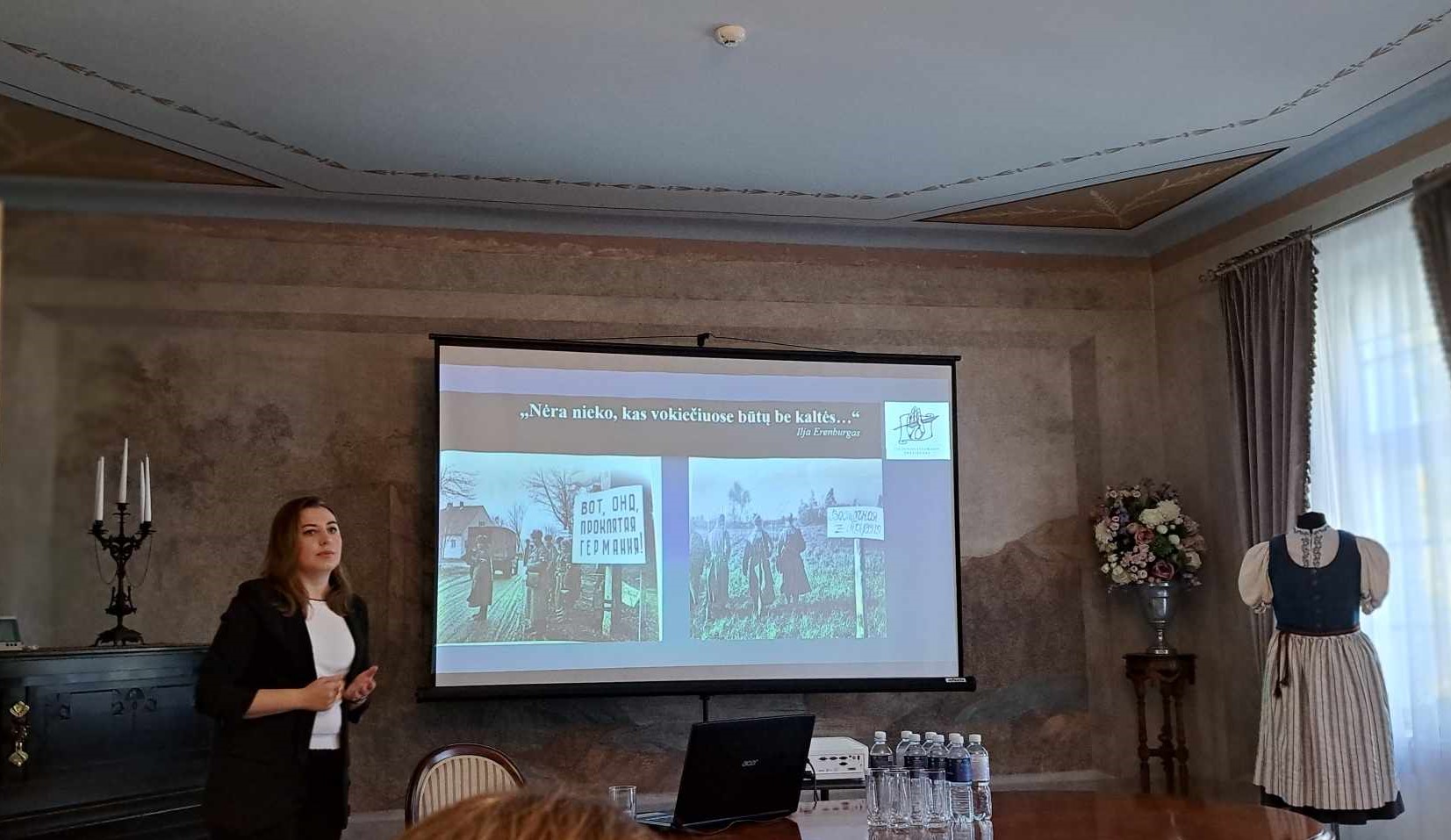
During the lecture at the Hugo Šojus Museum in Šilutė
Research Results and What Comes Next?
The AABS dissertation project was a unique academic and personal experience. The diversity of countries, people, sources, and their dispersion across the region highlighted the importance of connecting materials from different archives and contexts. At the same time, it was a personal challenge, as I had set an ambitious goal to encompass such a wide range of contexts and material. The data collected will be integrated into my doctoral dissertation and presented at the EUROPAST international conference “Past and Future of Public History,” where I will give a presentation titled “Graves and Stories: Multidirectional Memory at Oksbøl Refugee Camp.” In addition, two separate publications are planned: one on refugee children’s drawings, and another on the intersections of migration and epidemics in the Soviet Baltic republics.
– Rūta Matimaitytė, 2025
Rūta Matimaitytė