
Webinars
Since the February 2022 invasion of Ukraine, AABS has hosted a series of panels featuring Baltic and Ukrainian scholars and their research. Topics have ranged broadly, encompassing timely geopolitical discussions, revelations from new research in memory and society, and more. The AABS Board welcomes suggestions from members on future webinar topics.
Events
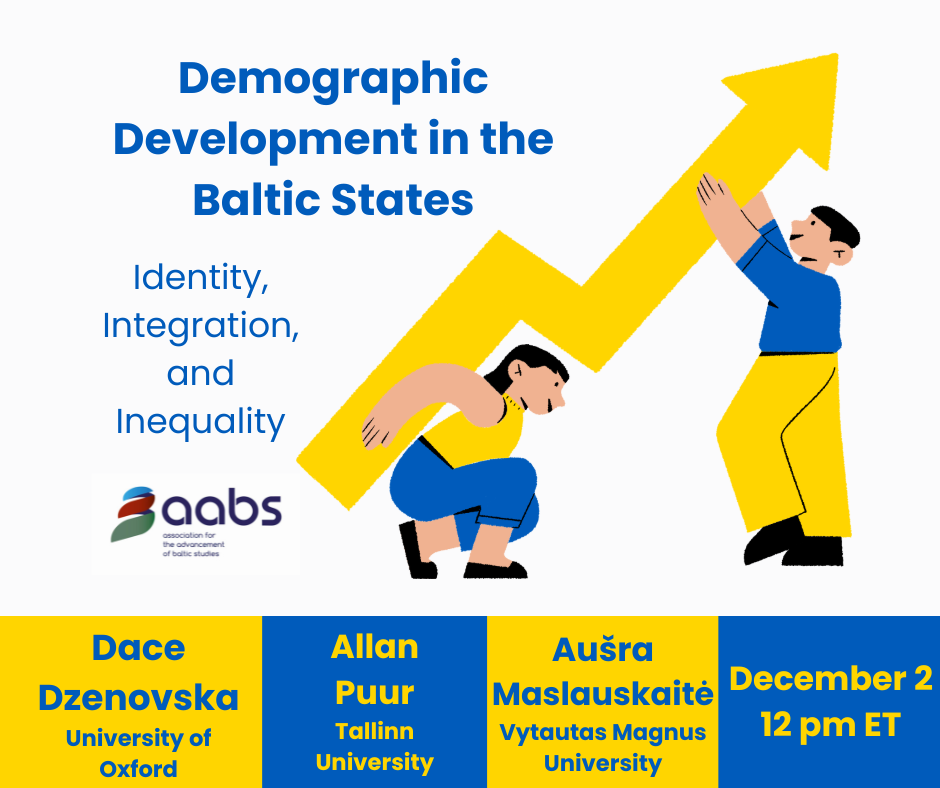
December 2, 2025
Demographic Development in the Baltic States: Identity, Integration, and Inequality
The Baltic states of Estonia, Latvia, and Lithuania each experienced substantial population declines since the fall of the Soviet Union. While the welcoming of Ukrainian refugees and return migration suggest that it might be possible to reverse these trends, such reversal is far from certain. This webinar asked the following questions: What is the impact of this long-term decline and its recent reversal? How do Baltic societies cope with both the loss and the gain? What effects do these changes have on the civil life and politics of the three countries?

May 5, 2025
The End of the Liberal World Order: What Comes Next for the Baltic States?
Following the end of the Cold War, the U.S. has been the main advocate for a rules-based liberal world order that champions democracy, free trade, and human rights. The Baltic states eagerly signed on, as exemplified in their successful efforts to obtain EU and NATO membership in 2004, and have benefitted from the system. But this world order is no more. With Donald Trump’s 2025 return to power, the U.S. will no longer be the advocate it once was. Other powers, chiefly Russia and China, welcome this change and seek to reshape the international system in accordance with their own values and imperial interests. This event discussed the following: What do these changes mean for the Baltic states and their neighbors? How will the American retreat from defending liberal values affect European and Baltic security? What actions can the Baltic states take to ensure the prosperity and freedom they have enjoyed for the last few decades?

March 10, 2025
The Fate of Europe: Ukraine, the Baltic Region, and Collective Security
Since 2014, the Ukrainian state and society have shown strength and resilience in resisting Russian aggression. Given the decisions of the new United States administration to engage Putin’s Russia and chastise Ukrainian leadership, this discussion questioned: will Ukraine be able to continue defending its sovereignty? What are the implications of the recent changes in the US position towards Russia for European security, including Nordic and Baltic security? How will Europeans approach their collective security in a new era of transatlantic relations?

January 28, 2025
Confronting the Truth: Pursuit of Historical Justice in the Baltic States and Beyond
After the breakup of the Soviet Union, the Baltic states have focused on pursuing historical justice related to Soviet crimes, which included widespread repressions and mass deportations. Under the influence of international actors, the Baltic states have also engaged in political processes associated with Holocaust justice such as the Terezin Declaration. While the Terezin Declaration emphasizes the importance of economic restitution, many Holocaust survivors and their families understand justice in terms of the “right to truth,” in which restitution is interconnected with the restoration of personal dignity, recognition, memorialization, education, and inclusion into society. Panelists at this event asked: What would the “right to truth” entail in the Baltic states, and is there political will to pursue it? How can Baltic societies pursue historical justice both in relation to the Holocaust and Soviet crimes? How has the Russo-Ukrainian war affected attempts to pursue historical justice in the Baltic states and the broader region?

October 8, 2024
Gender, War and Memory: The Baltic States and Ukraine
An exploration of the intersection of gender, war and memory often implies that women are studied primarily as the victims of war and other traumatic events. The goal of this discussion was to challenge this trend by analyzing the narratives and depictions of the traumatic experiences of women in several wars—including World War II and the ongoing Russo-Ukrainian war. How do women who were (or are) engaged in war depict their roles as related to violence as well as the traumatic experiences of torture and deportation? How do they cope with traumatic memories? Are those memories transformed into empowerment through political activities? What is their relationship with the national and transnational war narratives in the Baltic states and Ukraine?

February 12, 2024
Democracies during War: Ukraine and the Baltic States
There is no shortage of critical situations challenging the survival of democracies in Ukraine and the Baltic states. The pandemic coincided with rising populism and challenges to the legitimacy of the government. And even worse was yet to come—in 2022, the full-scale invasion of Ukraine by Russia presented the entire democratic world with an unprecedented challenge of maintaining the liberal world order and supporting democratic rule. In the face of this challenge, the war has revealed the enormous ability and enthusiasm of civil society in Ukraine and the Baltic states to mobilize to resist Russia’s aggression. Expert panelists at this event addressed the following questions: What accounts for this successful mobilization? Is this a guarantee of the survival of democracies in Ukraine and the Baltic states? As the war continues, what are the main challenges faced by these democracies?

October 4, 2023
Decolonizing Effects of the War in Ukraine: Baltic and Ukrainian Perspectives
The webinar addressed the full-scale war in Ukraine as a potential move toward decolonization. Decolonization refers to resisting Russia and asserting new identities and subjectivities. Which processes of decolonization are taking place in Ukraine and the Baltic states? What will be the impact of this war on challenging imperial hierarchies in international relations? What will be its impact on domestic developments?

May 11, 2023
A Stronger Alliance: NATO and the War in Ukraine
Russia’s aggressive war against Ukraine has resulted in a major change in Northern Europe’s security landscape. In April 2023, Finland became the 31st member of NATO, ending its decades-long policy of military non-alignment. Sweden is eager to join NATO as well. This webinar asked pertinent questions: What does this historic development mean for the alliance, including the Baltic states? Does Finland’s decision to join NATO to secure its freedom represent a possible model for Ukraine? How did the war in Ukraine and Finland’s NATO membership fundamentally reshape Baltic security?

January 18, 2023
Imagining Postwar Ukraine and its Place in Europe
This roundtable brought together scholars from Ukraine and the Baltic states to discuss the current state of the war in Ukraine as well as imagine the future of the country and the challenges and opportunities the postwar period will bring for Ukraine and Ukrainians. What pressing issues will Ukraine have to address after the war? What will postwar justice look like? Why are these developments important for the Baltic states?

April 28, 2022
The Work Goes On: Ukrainian Scholars Speak on Society, Migration, and Memory
This roundtable brought together three scholars from Ukraine – Tymofii Brik, Kateryna Ivashchenko-Stadnik, and Sergii Pakhomenko – in order to discuss their recent work on society, migration, and memory, and the ongoing war’s effect on the Ukrainian academia and research.

April 21, 2022
The Work Goes On: Ukrainian Scholars Speak on Security, Development, and Regional Cooperation
This roundtable brought together three scholars from Ukraine – Volodymyr Dubovyk, Pavlo Fedorchenko-Kutuyev, and Marianna Gladysh – in order to discuss their recent work on security, development, and regional cooperation, and the ongoing war’s effect on the Ukrainian academia and research.

March 7, 2022
Ukraine: War, Solidarity, and European Security. A Roundtable Discussion
In the immediate aftermath of Russia’s full-scale invasion of Ukraine in February 2022, AABS and the American Association for Ukrainian Studies co-hosted this event just two weeks later to process and assess what was happening. Experts Oxana Shevel, Andres Kasekamp, and Dovilė Budrytė joined to share their thoughts.