
The Association for the Advancement of Baltic Studies is pleased to announce that Laima Vincė Sruoginis has been awarded the 2026-2027 Baumanis Grant for Creative Projects in Baltic Studies to support For Our Freedom, her historical novel in development.
The Baumanis Grant is an award made to honor Velta Marija Baumanis of Mount Brydges, Ontario, who left a generous bequest to AABS at the end of her career as an architect. An award of up to $7,000 is available for any creative project (e.g., book, film, exhibit, etc.) that promotes Baltic studies. Preference is given to topics with a pan-Baltic or comparative aspect. Applicants must be members of the AABS at the time of application.
The 2026 applications were evaluated by the AABS 2025-2026 Grants and Awards Committee consisting of AABS VP for Professional Development Dr. Kaarel Piirimäe, AABS President Dr. Jörg Hackmann, and AABS Director-at-Large Dr. Dovilė Budrytė. Learn about the other 2026-2027 recipients here.
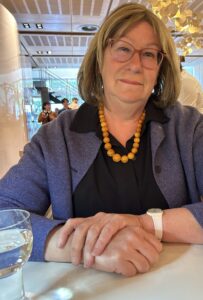
Laima Vincė Sruoginis is an author, translator, and scholar. She earned a Ph.D. in Humanities from Vilnius University, an M.F.A. in Writing from Columbia University, an M.F.A. in Nonfiction from the University of New Hampshire, a B.A. in English and German literature from Rutgers University, and a B.F.A. in Studio Arts with a concentration in Painting and Drawing from the University of Southern Maine. Vincė Sruoginis is the recipient of numerous grants, including the AABS Book Subvention Grant and AABS Dissertation Grant. She was most recently a postdoctoral researcher at the Lithuanian Emigration Institute at Vytautas Magnus University, a Visiting Scholar at the Oxford Centre for Life-Writing in Oxford, England, and at the Center for Cultural Research at Konstanz University in Konstanz, Germany.
Writing under the name Laima Vincė, she has published over 20 books in the United States, Europe, and the United Kingdom, including Vanished Lands: Memory and Postmemory in North American Lithuanian Diaspora Literature (Peter Lang International Academic Publishers, 2023), The Cerulean Bird: Poems by Matilda Olkinaite (Arc Publications), Heritage, Connection, Writing: Conversations with North American Lithuanian Diaspora Writers (Peter Lang International Academic Publishers, 2026), That Unspoken Word (Amber Bay Press, 2025).
Project Overview: For Our Freedom
I am extremely grateful to AABS for awarding me the Baumanis Grant for Creative Projects, which will enable me to research, write, and publish my historical novel, For Our Freedom. The theme of the novel centers around the courageous path Lithuanians, Latvians, and Estonians took to regain their independence from the Soviet Union in the late eighties and early nineties. The novel explores the complex relationship between the independence movements in Lithuania, Latvia, and Estonia, leading to the establishment of the Baltic Assembly in Tallinn in April 1989. At the first Baltic Assembly, plans are made to organize the Baltic Way, an unprecedented movement where nearly two million people across Lithuania, Latvia, and Estonia, on August 23, 1989, the fiftieth anniversary of the signing of the secret protocols of the Molotov-Ribbentrop Pact, joined hands to form a human chain across the Baltics, extending from Vilnius to Tallinn. The Baltic Way unequivocally showed the world that the Baltic States sought their independence from the Soviet Union. The Baltic Way brought the Singing Revolution from the streets of Vilnius, Riga, and Tallinn to the entire world.
For Our Freedom is a sequel to my novel, This is Not My Sky, which was published in the United States in 2017, and then published in 2019 by Alma Littera, the largest commercial publisher in the Baltic States, in Lithuanian translation as Tai ne mano dangus. In the final scene of this novel, American born Nora, the daughter of Maria, a postwar immigrant from Lithuania via Poland, prepares to travel to Soviet-occupied Lithuania with Baba, her grandmother, to carry the small cross that belonged to her sister, Milda, who has died of AIDS, to the Hill of Crosses in Lithuania—a site of religious and political resistance against the Soviet Russian occupation. Nora and Baba arrive in Lithuania in the summer of 1988, just as the independence movements in Lithuania, Latvia, and Estonia are sending a seismic wave of hope and resistance across the Baltic States. National symbols and flags from the period of interwar independence are flying across the Baltics during massive peaceful demonstrations for the first time since 1940. Roko maršas, a rock and roll movement of national rebirth, has captivated young Lithuanians, drawing them into the movement for freedom. What was originally for Nora a deeply personal journey, centered around family, memory, and learning about her Lithuanian identity, shifts into a political mission as she decides to stay in Lithuania under the guise of studying the Lithuanian language at Vilnius University while volunteering as a translator for Sąjūdis, the Lithuanian independence movement. Nora’s naivety, idealism, lack of local knowledge, and North American optimism set her up as a person of interest for the KGB. She soon no longer knows who to trust. Even her circle of friends begins to seem suspect as tensions rise in the Baltics.
I lived through these events. I came to Lithuania as a student of Lithuanian literature at Vilnius University in September 1988 and soon afterwards became a volunteer translator for Sąjūdis. In addition to archival research, interviews, visits to memory sites, I will draw from my own personal experience as a young demonstrator, activist, and folk singer in Lithuania in the late eighties and early nineties. I was an interpreter at the first Baltic Assembly in Tallinn in April 1989 and held hands in the human chain during the Baltic Way on August 23, 1989. However, despite my personal experience of living through the years of the independence movements in the Baltic States, my novel is a work of fiction. Through fictional characters that are composites of the many types of people I knew who participated in the independence movement, I wish to recreate the real-life tension and uncertainty of those years when the Baltic States seized the historical opportunity to make their independence from Soviet Russia a reality. Thousands of Estonians, Latvians, and Lithuanians made significant personal sacrifices for independence, for their freedom. Then, after independence, across the Baltics people worked hard to rebuild their homelands after the collapse of the Soviet Union left economic upheaval and dire living conditions. Thirty-six years later, a new generation has come of age that views those years through a romanticized lens. By depicting the lives of real everyday people from those times, For Our Freedom will show the complexity of what it took to achieve that freedom.
The character, Nora, represents the many North American born Lithuanians, Latvians, and Estonians who travelled to their parents’ and grandparents’ homelands in the eighties and nineties led by a vision of participating in the social movement of restoring the nations that their families had lost to Soviet Russian occupation. In today’s independence narratives, the role played by North American born descendants of displaced persons who participated in the independence movement is largely forgotten. Through historical fiction, I hope to show an important social phenomenon when people from the three Baltic States, who shared the same historical fate, came together to turn history around. The years of the independence movement were a time when thousands across the Baltics were prepared to sacrifice their lives for freedom. This novel is a work of memory that honors their sacrifice.
As a researcher and the author of two academic monographs, Vanished Lands: Memory and Postmemory in North American Lithuanian Diaspora Literature (Peter Lang International Publishers, 2023) and Heritage, Connection, Writing: Conversations with North American Lithuanian Diaspora Writers (Peter Lang International Publishers, 2026) I have experience working with archival research, oral histories, and documenting historical, cultural, and social movements. I will spend time in Latvia and Estonia, as well as Lithuania, to work with resources there and learn more about the Latvian and Estonian independence movements. I will also work with archives and interview surviving signatories of the declarations of independence. My own published diary of the years of the independence movement, Lenin’s Head on a Platter (Lithuanian Writers Union Publishers, 2009) will also serve as a resource.