
The Association for the Advancement of Baltic Studies is pleased to announce that Lisa Trei has been awarded the 2026-2027 Baumanis Grant for Creative Projects in Baltic Studies for her forthcoming exhibition about photography in the Baltic states shortly after the restoration of independence in the early 1990s.
The Baumanis Grant is an award made to honor Velta Marija Baumanis of Mount Brydges, Ontario, who left a generous bequest to AABS at the end of her career as an architect. An award of up to $7,000 is available for any creative project (e.g., book, film, exhibit, etc.) that promotes Baltic studies. Preference is given to topics with a pan-Baltic or comparative aspect. Applicants must be members of the AABS at the time of application.
The 2026 applications were evaluated by the AABS 2025-2026 Grants and Awards Committee consisting of AABS VP for Professional Development Dr. Kaarel Piirimäe, AABS President Dr. Jörg Hackmann, and AABS Director-at-Large Dr. Dovilė Budrytė. Learn about the other 2026-2027 recipients here.
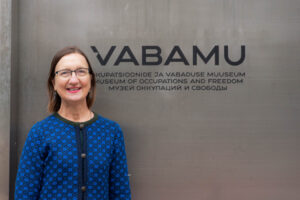
Lisa Trei is a writer, editor, and storyteller. In 1990, she was the first Western-trained reporter invited to teach practical journalism at Tartu University, and in 1996 she published “Uuriv ajakirjandus,” Estonia’s first handbook on investigative journalism. Trei covered the collapse of the Soviet Union and the early years following the restoration of Baltic independence for many U.S. newspapers, including The Wall Street Journal. From 1997 until her retirement in 2023, Trei worked in communications roles at Stanford University in Palo Alto, California. She is a member of the Estonian Society of San Francisco and the Estonian-American National Council. In 2023, Trei returned to Estonia to pursue a master’s degree in Estonian Studies at Tallinn University and was awarded a Fulbright Specialist grant to work with Vabamu Museum. She has developed two exhibits for Vabamu, both focused on migration and movement.
Project Overview: the Baltic states through a photographer’s lens in the pivotal years of 1991 and 1992
A photographic exhibition opening in February 2027 at Vabamu Museum of Occupations and Freedom in Estonia will feature remarkable images that illustrate life in the Baltic states shortly after the restoration of independence in 1991.
The images, which have never been publicly presented as a collection, were captured by Bob Stern, a former photographer for The Hartford Courant in Connecticut, USA. He spent the summers of 1991 and 1992 in the Baltic states working with Lisa Trei, then a U.S. foreign correspondent and an editor at The Estonian Independent in Tallinn. The journalists traveled up and down the Baltics, covering stories about everyday life for a planned book about the region that was not completed for financial reasons.
In 2023, Lisa Trei returned to Estonia to pursue a master’s degree in Estonian Studies at Tallinn University and work at Vabamu Museum as a Fulbright Specialist. She discovered that Estonia was no longer a post-Soviet society and had in many ways become, in the words of former President Toomas Hendrik Ilves, “another boring northern European country.”
Attending college classes with students in their 20s, Lisa Trei realized that many people in the Baltics today are too young to remember the turbulent early 1990s. She contacted Bob Stern to ask what happened to his photography collection and learned that parts of it were still intact but had never been published.
“The Baltic states through a photographer’s lens in the pivotal years of 1991 and 1992” tells the story of a region in transition. It portrays aspects of life—Lithuania’s fledgling military, city scenes in Riga, and pollution in northeast Estonia—that have changed dramatically during the past 35 years. Despite current challenges related to national security, economics, and the environment, Estonians, Latvians, and Lithuanians have successfully built functioning, democratic societies following the long Soviet occupation. The images in the Bob Stern Collection highlight what life was like in the Baltics when this transition began. The exhibition will be presented in Vabamu’s KGB Prison Cells in Tallinn’s Old Town.