
AABS is pleased to congratulate Feliks Gornischeff for the completion of the Emerging Scholars Grant (awarded 2025) associated with his book manuscript on the legacy of Baltic German diplomats in the Russian service.
Gornischeff used the Grant to conduct primary source research at the United States Library of Congress (LOC) and National Archives (NARA). He shared his thoughts with AABS, which we have lightly edited and published below.
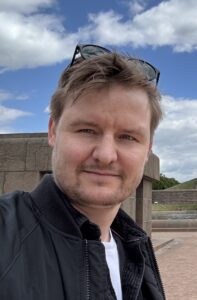
©Feliks Gornischeff, 2026
Dr Feliks Gornischeff is a researcher at the Estonian Maritime Museum, where he is conducting research on Baltic German explorers in the first half of the 19th century. In 2020, he defended his PhD (University of Tartu) on Baltic German diplomats during the Napoleonic Wars. Gornischeff’s research interests include the service of Baltic Germans in the Russian Empire, the international networks of Baltic Germans, and maritime and diplomatic history of the early 19th century.
Revisiting the Legacy of Baltic German Diplomats in the
Russian Service in the Early 19th Century
Emerging Scholars Grant Report from Feliks Gornischeff
My research trip to Washington D.C. in January-February 2026 allowed me to concentrate on my book project that will be based on my doctoral dissertation defended at the University of Tartu in 2020. My goal was to do research at the Library of Congress (LOC) and the National Archives (NARA), where extensive source material covering early 19th century diplomatic affairs is held.
My main goal was to map and collect Russian archival material that was copied in the framework of the Foreign Archive Copying Program. During this program, extensive archival material related to the history of the US in European archives was copied. In addition to Russia, documents were collected from Germany, Austria, France, UK etc. Being able to physically do research at the LOC and NARA led me to investigate new possible angles and sources. As Samuel Flagg Bemis stated in 1935, “Very frequently the diplomatic activities between two countries, A and B, are reflected not only in their own diplomatic correspondence and conversations and supplementary foreign office records, of the kind described above, but in the correspondence of A with C, and D; or of B with C and D, or X, or even of C and D with E, F, and X.” So, for example, when looking into the US-Russian diplomatic relations in the early 19th century, this statement becomes quite obvious. It is not enough to only investigate the activities of the Russian ambassador to the United States or the American ambassador to Russia, but it is more than helpful to look into the role of American diplomats in England and France, or the role of Russian diplomats in England and France etc.
In general, the sources consulted in the LOC and NARA could be divided into four larger groups: official US diplomatic papers, copies of primary Russian sources, personal collections of American diplomats, and secondary literature and published sources together with numerous source books.
The official US diplomatic documents held at the NARA (diplomatic instructions; despatches from diplomatic officers; notes from foreign missions; notes to foreign missions) are mostly accessible online. During the physical visits to the NARA reading room in College Park it was possible to consult some materials that are not digitized, but these contained mostly the same materials (duplicates) as the online materials. Consultation with the archive staff also did not suggest that there had been any copying program that would contain materials from the Russian archives. Therefore, analysis of these official papers will be conducted in due course.
There is, however, a significant collection (Foreign Copying Program; microfilm and physical copies) of the Archive of the Foreign Policy of the Russian Empire (AVPRI) at the LOC that contains official correspondence of the first Russian envoy to the United States, Friedrich Alexander von der Pahlen (between 1809–1811) with his foreign minister and correspondence of the US envoy to Russia John Quincy Adams (between 1809–1814) with Russian officials. I also managed to copy the full instructions given to Pahlen by Alexander I. Based on these documents I began drafting an article outline that would look into Pahlen’s role as a Russian envoy in the US. Although there has been some research about the role of Pahlen, it is of a more general nature. The Russian Foreign Ministry collection also contains copies of documents regarding the Russian offer of mediation in the War of 1812 that sheds light onto another Baltic German diplomat, Christoph Heinrich von Lieven, who served as the Russian ambassador to the UK between 1812 and 1834.
The LOC also has numerous personal collections (accessible on microfilm) of American diplomats that were active in Europe during the early 19th century. While it was interesting to see how the Americans established themselves in Europe diplomatically in the early 19th century, it also became evident that the US did not have official diplomatic relations with Prussia and Austria – countries that align the most with the service of Baltic German diplomats. Despite this, the Americans were represented in Sweden, Denmark, Holland, France and UK, but also Portugal and Spain in the south. Therefore, the first thing was to identify all American diplomats in Europe in the first quarter of the 19th century and see how their posts aligned with the ones of Baltic Germans. Names such as James Monroe, John Quincy Adams, Albert Gallatin, Jonathan Russell, John Armstrong, Richard Rush to name a few stood out. Richard Rush, for example, served as the American ambassador in London during Lieven’s years and the collection therefore contains correspondence between the two.
I also started adding data to Nodegoat, a web-based network research tool that can be used to build a dataset and help visualize it. The following figure shows the places of residence (incomplete) of some Baltic German diplomats in the first quarter of the 19th century. Nodegoat also allows to insert correspondence which will in turn allow deeper analysis of diplomatic networks.
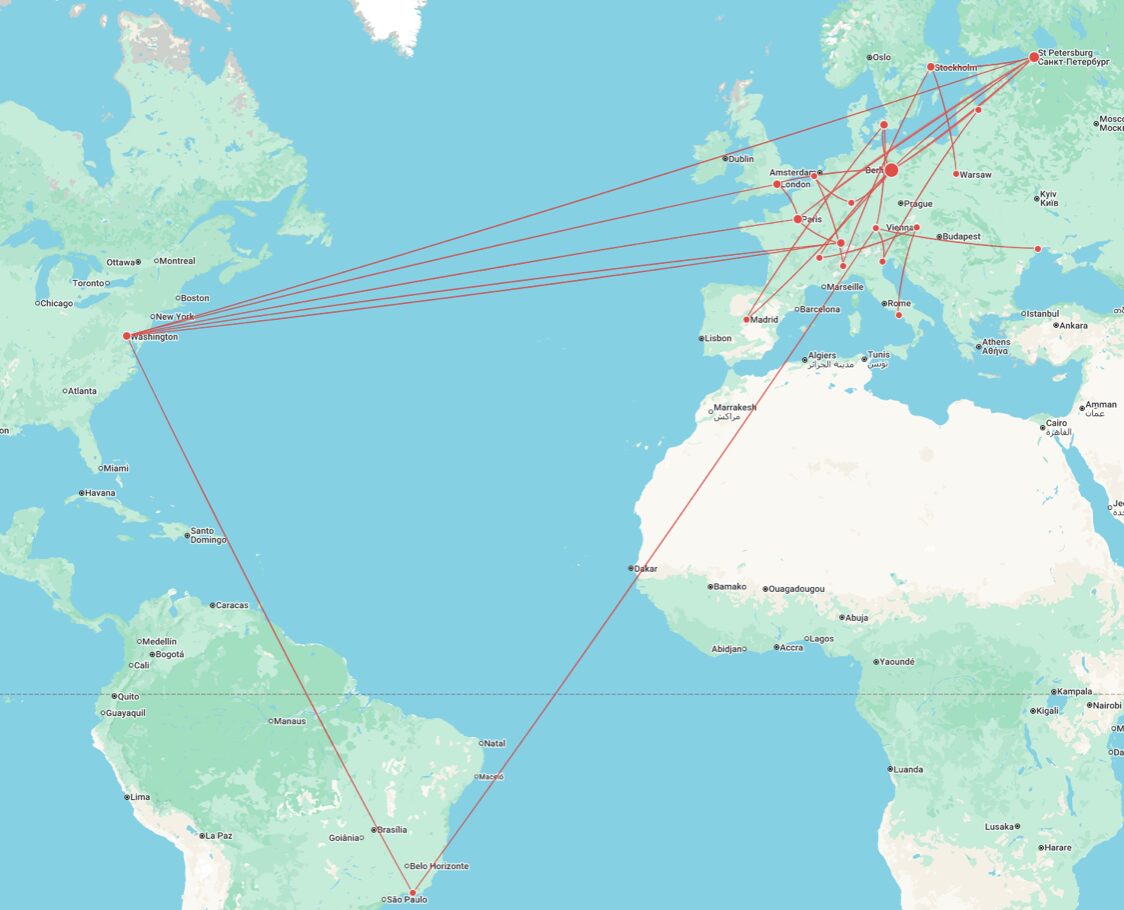
The next step is to organize the collected material and start systematic analysis – this includes deficiencies in material and possible future needs for research in Washington D.C.. There are still significant gaps in historical knowledge that can be filled with the help of these sources. And since the scope of my research widened during this trip, there will be a need to restructure my book project. Finally, work with secondary literature will be an ongoing process that opens new channels of research.
– Feliks Gornischeff, 2026
Gornischeff
What is the Emerging Scholars Grant?
The Research Grant for Emerging Scholars is an award for up to $6,000, to be used for travel, duplication, materials, equipment, or other needs as specified. Proposals are evaluated according to the scholarly potential of the applicant and the quality and scholarly importance of the proposed work, especially to the development of Baltic Studies. Applicants must have received their PhD within the last ten years. Applicants must be AABS members at the time of application.
Other Grants and Fellowships News

Documenting the Early Latvians of Philadelphia: Baumanis Grant Report from Peter Dajevskis
AABS is pleased to congratulate Peter Dajevskis for completing his project "Seeking New Beginnings, 1890-1910: The Free Letts," for which he received the Baumanis Grant for Creative Projects in Baltic Studies. Dajevksis and director Māra Pelēcis delved into the...

Justina Smalkytė Awarded JBS Publication Development Gran
The Association for the Advancement of Baltic Studies is pleased to announce that Justina Smalkytė has been awarded the 2026-2027 Journal of Baltic Studies Publication Development Grant to support her research on Jewish defendants tried in Soviet-occupied Lithuania....
Holger Mölder Awarded 2026-2027 Academic Events and Projects Grant
The Association for the Advancement of Baltic Studies is pleased to announce that Holger Mölder has been awarded a 2026-2027 Academic Events and Projects Grant to support the workshop “The end of democracy? Is the populist wave unstoppable?” scheduled for June 30,...
Renew your membership or join for 2023 online or by mail.
Donate
Contribute to the Baltic Studies Fund (BSF) or AABS program expenses to ensure the future well-being of AABS.
Connect with AABS
Find AABS on the following networksNewsletter
Lokal_Profil (CC BY-SA 2.5) | © 2022 The Association for the Advancement of Baltic Studies (AABS) | A member of the American Council of Learned Societies