
AABS is pleased to announce that Central European University (CEU) Press has been awarded the AABS Book Publication Subvention for publishing “The Duchy of Courland’s Colonial Networks: Seventeenth Century Encounters from the Baltic to the Atlantic,” by John Freeman.

John Freeman is a historian of the early modern Baltic Sea, focusing on commercial and maritime connections between the Baltic and the Atlantic Ocean during the seventeenth and eighteenth centuries. He has predominantly written on the seventeenth century colonial ambitions of the Duchy of Courland in the Caribbean and Western Africa.
John received his PhD from the University of Cambridge in 2022. He most recently worked as an Assistant Professor at the Centre for Global History, University of Warsaw. Prior to this post, he has been employed as a fellow at the Interdisciplinary Centre for Baltic Sea Research (IFZO), University of Greifswald, and as a research assistant at the Centre for Geopolitics, Cambridge. He is a co-convenor for the BASEES study group on the Baltic States and won the Atlantic Studies journal Early Career Essay Prize in 2023.
Book Summary
The Duchy of Courland’s Colonial Networks: Seventeenth-Century Encounters from the Baltic to the Atlantic considers a little-known transatlantic venture originating from the Eastern Baltic. The Duchy of Courland and Semigallia, a vassal state of the Polish-Lithuanian Commonwealth occupying territory that is now part of Lativa, appears an unlikely source of colonial ambitions. Nevertheless, under the initial impetus of Duke Jakob Kettler, Couronian ships sailed to Western Africa and the Caribbean, partaking in trade for ivory, pepper, sugar, tobacco and enslaved Africans. The Courlanders erected their first fortress on the River Gambia in 1651, followed by another on the Caribbean island of Tobago in 1654. The effort to broaden the reach of Courland’s fledgling merchant fleet also encompassed a trading post at the River Sierra Leone and iron mines in Norway.
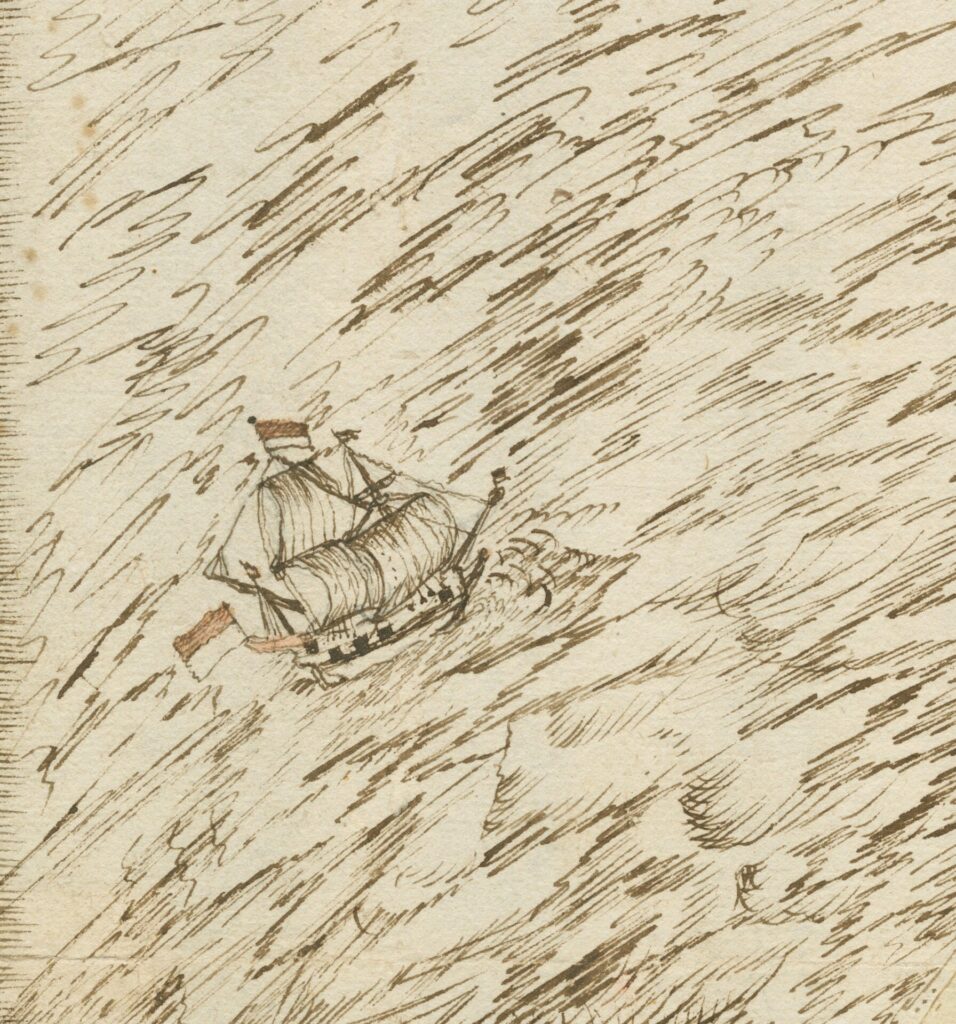
Latvian State Historical Archives 7363-3-111 fol. 552v
While the Couronian presence in Africa and the Caribbean was fleeting- both fortresses were abandoned by 1661 and attempts to re-establish them effectively ended by 1700- the monograph argues that the episode is still significant in the study of Atlantic and colonial history. The topic affords an opportunity to investigate the colonial strategy of an extreme small-power polity, which struggled to exert autonomy in its domestic sphere. Duke Jakob used this venture to gain personal wealth and prestige given restrictions upon his power enforced by the Couronian nobility with the support of the Commonwealth. It is also an example of direct Baltic and Eastern European encounter with Africa and the Americas, at a time when such instances were remarkable. The monograph asks whether the Couronian approach to early colonial expansion was different in contrast to European contemporaries or if it borrowed any features and attitudes from experience in the Eastern Baltic. This question is somewhat pertinent given ongoing debates about whether Latvians and other Baltic populations colonized peoples during the medieval and early modern eras.
At the core of the study is the subject of networks. The duke called upon many different individuals to further Courland’s Atlantic endeavors, some from the duchy but many of them from abroad. The monograph aims to decenter the topic away from the singular figure of Duke Jakob, who, although significant, did not embody all of Courland’s colonial activities. By studying sources from various international archives, the book uncovers the networks which incorporated governors, soldiers, colonists, merchants, diplomats and sailors into the ducal project. It will ask how such people came to be recruited, why they were valued and which channels were utilized to further Courland’s reach beyond the Baltic and into the Atlantic. In contrast to a significant body historiography on the subject, the monograph downplays nationalist interpretations which have often emphasized the perceived German, Latvian and Polish elements of the endeavor. It will also update the field to include greater consideration of the Senegambian and Caribbean contexts, investigating the interaction between Couronian settlers and non-Europeans from an indigenous perspective. This approach is designed to provide a more fulfilling account of a highly noteworthy episode where people from the early modern Eastern Baltic acted upon a global stage.
What is the AABS Book Publication Subvention?
The AABS awards its Book Publication Subvention of up to $5,000 for individually authored books, edited volumes, and multiple-authored books in English that make a substantial scholarly contribution to Baltic Studies. The applications must be submitted by publishers, not authors. Priority will be given to single author’s first monographs.
AABS awards two Book Publication Subventions each year. Applications may be submitted for review anytime, on a rolling basis.
Other Grants and Fellowships News

Documenting the Early Latvians of Philadelphia: Baumanis Grant Report from Peter Dajevskis
AABS is pleased to congratulate Peter Dajevskis for completing his project "Seeking New Beginnings, 1890-1910: The Free Letts," for which he received the Baumanis Grant for Creative Projects in Baltic Studies. Dajevksis and director Māra Pelēcis delved into the...

Justina Smalkytė Awarded JBS Publication Development Grant
The Association for the Advancement of Baltic Studies is pleased to announce that Justina Smalkytė has been awarded the 2026-2027 Journal of Baltic Studies Publication Development Grant to support her research on Jewish defendants tried in Soviet-occupied Lithuania....
Holger Mölder Awarded 2026-2027 Academic Events and Projects Grant
The Association for the Advancement of Baltic Studies is pleased to announce that Holger Mölder has been awarded a 2026-2027 Academic Events and Projects Grant to support the workshop “The end of democracy? Is the populist wave unstoppable?” scheduled for June 30,...