

Patrick Monson recently completed a PhD in History from Princeton University, where he studied East European/Russian imperial and legal history. His research has been supported by Fulbright, ASEEES, AABS, and others. He currently serves as a digital archivist at FamilySearch, preserving archival documents in several Eurasian countries; and as an adjunct faculty for paleography at BYU-Idaho.
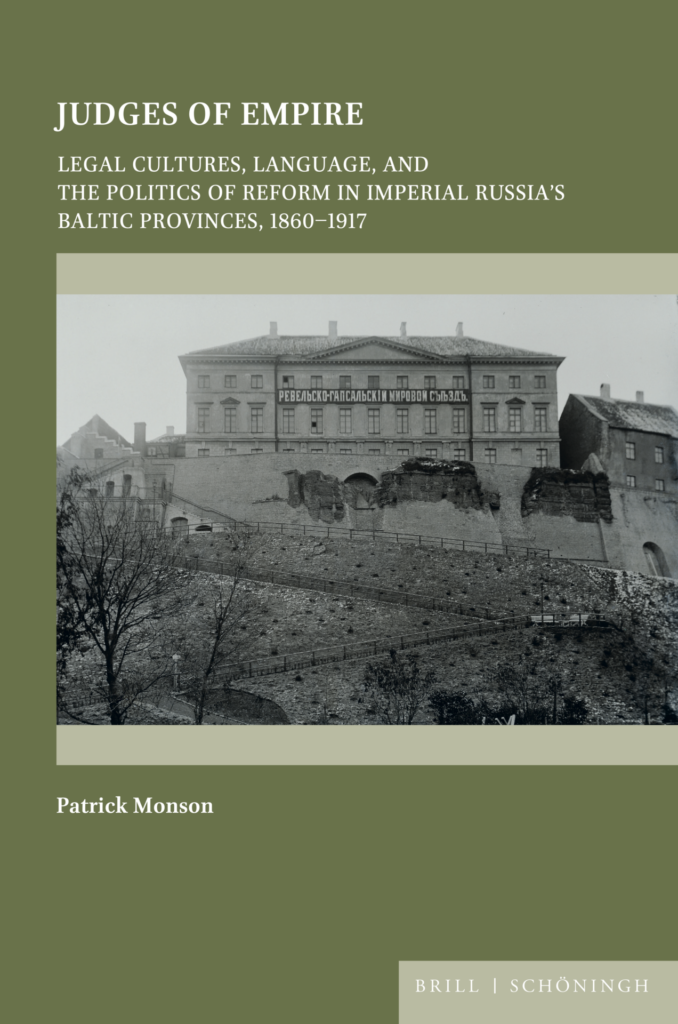
The AABS Emerging Scholars Grant has contributed greatly to my forthcoming book. Just last night, I submitted it to the press for typesetting. It will be published in May of next year by De Gruyter Brill, as part of its series On the Boundary of Two Worlds: Transregional Baltic Studies. I used the funds for living expenses, copyediting, and to help pay for a research trip to Estonia. While I had spent a combined total of a year working in Estonian (Tartu), Latvian (LVVA), and Russian (RGIA) archives studying imperial Russia’s attempts to reform Baltic courts and administer local law, I hadn’t spent any time studying Baltic courts during the revolutionary and post-war periods, which my PhD adviser suggested would round off my book as an extended epilogue. Since I speak Estonian, but not Latvian, I focused my efforts there.
I set out to understand how jurists in the new Estonian and Latvian Republics handled legal and linguistic diversity. From preliminary reading, I understood that they, much like imperial officials before them, appropriated many administrative and procedural forms and norms—and essentially the same civil law—from preceding eras. Baltic civil law, in fact, has never been fully translated. Scholars have shown that many legal terms, though, were coined after 1918—how did new judges handle complex legal cases prior to and after the advent of these new terms? I knew that in Latvia, German- and Russian-speaking litigants could participate in proceedings in their native languages, much like some officials had proposed decades earlier. Was this the case in Estonia? Who acted as judges in these instances, and how did they communicate with litigants?
I spent a week in the Estonian National Archive in Tallinn, where I explored and photographed many administrative files and court cases, including fonds 15, Constituent Assembly Elections Main Committee, Constituent Assembly; 27, Tallinn-Harju Prefecture and Its Predecessors; 32, Court of Appeals; 76, Ministry of Justice; 1356, Supreme Court; 1947, Tartu Circuit Court; 2224, Ministry of Justice Sworn Translator Albert Leopas; and others. I’m happy to report that I made some fascinating archival discoveries on how the courts functioned after 1917, which I will sum up below.
As Estonian and Latvian armies defeated German and Bolshevik forces, they organized provisional governments, taking control of government institutions and functions. Establishing a well-functioning judiciary was one of their first and highest priorities. Just three days after the armistice, a justice of the peace temporarily appointed to Rakwere wrote to the new minister of justice, Jaan Poska, that he had taken over the courts, deed registry offices, and prisons, indicating that he was going to free all those being held for minor offenses. Creating a new court system proved to be no small task. In late November 1918, the Järwa district administration urgently requested that a justice of the peace be appointed to put “something of a limit on crime.” Kaarel Parts, the presiding judge of the Supreme Court, complained to Ministry of Justice officials that they had “debated things too long” and had not started their work in an orderly manner.
Staffing the courts was difficult because as a rule, judges had to be fluent in Estonian or Latvian. This did not mean that they had to be ethnic Estonians or Latvians, but that they had to be proficient in one of these languages. In one instance, Parts indicated that Paul Klein, a Tartu native who had been serving in interior Russia’s courts, was “unacquainted with our judicial order and does not have sufficient command of Estonian.” He suggested that Klein could do legal prep work for a few months before being assigned elsewhere.
Similarly, the lack of fully developed legal languages complicated the administration of law. After the founding of the new republics, legislators and especially law professors combined efforts with linguists to construct, reconstruct, and develop Estonian and Latvian legal languages. From there terms made their way into court rulings. In a 1923 Supreme Court ruling, for example, justices used the term päraldis for appurtenance, which translators had previously left untranslated in contracts. Yet five years later, Albert Leopas, translator for the Ministry of Justice, wrote that “the Estonianization of terminology related to […] civil process—and namely their exact expression in Estonian—causes great difficulties in the current condition of our language, which will require a great amount of time to overcome.”
How did the courts handle non-Estonian languages? Harking back to the policies proposed by Shuvalov and his colleagues, §23 of the Estonian constitution declared that German, Russian, and Swedish minorities had the right to address state institutions in their own languages, and that a special law would be issued delineating the use of these languages in local state institutions and courts. The special law stated that during trials, litigants could use other languages if the judges knew those languages. Litigants could submit requests to and receive notifications from justices of the peace in their own languages, provided the judge knew that language or had a translator.
This special law did not appear, however, until 1934. How did the courts interact with litigants up to that time? A thorough analysis of court files reveals that judges often communicated with non-Estonian litigants in their native languages. As in the preceding era, bilingual judges, notaries, lawyers, policemen, and other officials often communicated directly with litigants or acted as translators. In areas with large Russian populations, particularly in the east, judges indicated that issuing decrees and notifications in Russian “does not present any difficulties for the courts or judicial officials,” even though many judicial officials had Estonian names.
The multilingual policy was not implemented without resistance. A minority of legislators in Estonia thought it was “inappropriate” to allow people to communicate with the government in languages other than Estonian. They argued that this would “complicate the work of central institutions and compel each of them to keep two to four translators.” Echoing comments by imperial Russian officials, they worried that people who knew some Estonian would privilege the use of other languages. One official insisted, “We are a coastal people, we have dealings with many peoples. Granting all of them right to communicate with the government in their own language is not possible, because we cannot conceivably appoint officials who know all languages.” Despite this opposition, the multilingual policy received official sanction.
As in the preceding period, translation encountered issues. Recipients of Leopas’s translation services complained that he had translated some passages incorrectly. In one case, he translated guberniia (province) as valitsus (government). In another, he translated “rabbles” as rahvakiht (stratum of population). Perhaps most egregiously, he inadvertently translated Uchitel’skaia seminariia (Teacher’s Seminary) as Petajate Seminar (Cheater’s Seminary), apparently overlooking the Õ in Õpetajate. It seems that complications with translation are inevitable wherever people speak different languages.
How did the new courts handle Baltic law, which had not been translated into Estonian? Initially, due to the language requirement, many lower-level judges did not have law degrees. The state procurator, Jaan Teemant, complained that some explanations in court rulings were incomplete and superficial. Similarly, some Estonian Supreme Court justices grumbled that justices of the peace and the peace courts did not pay attention to Supreme Court rulings. Yet the fact that cases could be appealed to higher courts helped ensure higher-quality legal decisions. August Loeber, Harald Jucum, Viktor Ditmar, and Dmitri Verkhoustinskii graduated from Dorpat University in 1889, when German was still the language of instruction, and Verkhoustinskii served as judge of a Baltic high peasant court and the Riga circuit court. Former Riga circuit court member Vladimir Bukovskii served on Latvia’s Senate. This fostered continuity of interpretation. These men, and many Estonian jurists who had served as lawyers or judicial candidates, were well versed in the Russian- and German-language law codes. In one case, Estonia’s Supreme Court justices cited the Baltic code, pre-1889 rulings, post-1889 rulings, Roman law sources, and commentaries such as Grimm’s Roman law commentary, illustrating how deftly they could handle law from multiple eras. In other cases, they and even lower-level judges cited rulings by the Imperial Russian Senate and Bukovskii’s commentary on the Baltic code.
Validating claims made by Jane Burbank and Frederick Cooper that plurality tends to resist pressures at homogenization (in Legal Pluralism and Empires), Baltic legal culture remained much the same as it had for centuries. Yet following Vivian Curran, as Estonian and Latvian became the primary medium for legal administration, the terrains of difference shifted, creating new orders of difference.
I am not sure what the future holds in store for me. I am currently working at FamilySearch, focusing on digitizing records in several northern Eurasian countries, especially Ukraine. Since 2021, we have partnered with 31 archives in Ukraine and digitized over 130 million images. Every couple of weeks, a drone or rocket will hit close to an archive, blowing out windows and damaging facades, but we have lost only one complete archive and portions of a few others. I help identify, label, and organize collections and direct strategy for our projects in the area. I feel like this is a significant contribution and may stay here while the records are at risk. I hope to continue doing research and writing, perhaps something related to borderland governance; unequal property policies, such as on Jews; social history of families; or something else (maybe even fiction inspired by Eastern Europe). Thank you for all your support!
– Patrick Monson, October 2026
Patrick Monson
What is the AABS Emerging Scholars Grant?
AABS invites applications for research grants of up to $6,000 in any field of Baltic Studies. Funds may be used for travel, duplication, materials, equipment, or other needs as specified.
Applications typically open in the late fall and close in February or March.
Other Grants and Fellowships News

Documenting the Early Latvians of Philadelphia: Baumanis Grant Report from Peter Dajevskis
AABS is pleased to congratulate Peter Dajevskis for completing his project "Seeking New Beginnings, 1890-1910: The Free Letts," for which he received the Baumanis Grant for Creative Projects in Baltic Studies. Dajevksis and director Māra Pelēcis delved into the...

Justina Smalkytė Awarded JBS Publication Development Grant
The Association for the Advancement of Baltic Studies is pleased to announce that Justina Smalkytė has been awarded the 2026-2027 Journal of Baltic Studies Publication Development Grant to support her research on Jewish defendants tried in Soviet-occupied Lithuania....
Holger Mölder Awarded 2026-2027 Academic Events and Projects Grant
The Association for the Advancement of Baltic Studies is pleased to announce that Holger Mölder has been awarded a 2026-2027 Academic Events and Projects Grant to support the workshop “The end of democracy? Is the populist wave unstoppable?” scheduled for June 30,...